Bringing Order to Chaos
Article

Paul Gallagher
I have been fortunate to photograph many landscapes in a variety of different countries throughout the world but the photographs I had seen of Japan always seemed to have a difference that was difficult to categorize and I have always been drawn to places that may challenge me as a photographer.
My default position is to normally head to locations that could be regarded as remote, or certainly feel that way. As well as feeling a long way from cities and towns, the landscapes I regard as my favourites are ones that appear almost untouched, although in reality, this is seldom the case as almost all of the landscapes I have experienced have been modeled and influenced by the hands of mankind. One of the main factors that made Japan, and Hokkaido in particular, fascinating was the apparent simplicity of the place, certainly in the deep winter months. One of the approaches I take as a landscape photographer is to distill the elements of the landscape down to understandable parts of a composition so that the photograph is not an overwhelming record of every aspect of the scene.
Traveling through countries as photogenic as Scotland, USA, Norway and Iceland, there is still the need to break down the enormity of the landscape and make photographs that say something about individual aspects of that landscape that I saw when I was there with my camera. The photographs I had seen of Hokkaido showed less of this process and in fact seemed to describe a landscape that was elemental and minimal in its own right with very little need for distillation at all. I began to wonder if photographing this type of landscape would be simple, or in fact, the very simplicity itself would be challenging.
The other appeal for me was most of the work I had seen in Hokkaido that captured my attention was taken in the winter months. Hokkaido is a place that is almost guaranteed beautiful winter snow, and lots of it, from the months of October though to March. It is the very occurrence ofsnow that puts a veil over the landscape and masks all but the woodland and some of the artifacts of the farming activity here that ceases completely during the winter.
After some deliberation I decided to make the journey to Hokkaido in early March and meet a local guide there. First impressions are of course very important and I would be lying if I did not say I was a little underwhelmed by the place making my way from the airport to my first hotel. The first thing that became apparent over the next few days was that very little of the island is what I would regard as remote and the island consists of many small towns that are linked by roads that service vast areas of managed farmland. Equally, the areas at the coast are semi-industrialised by the vibrant fishing industry which ranges from modern fishing ports to hundreds of small fisherman’s houses and huts that are occupied during the fishing seasons in the warmer months of the year
After a day or two I began to settle into the environment surrounding meand soon realised that it was my preconception of what I expected that was hindering me. Given all of the industrial installations and the managed farmland, the landscape was stark and cold. I suppose that I am so used to ‘entering’ the landscape and sensing a change from inhabited farm areas to something that appears protected and preserved in the formof a national park. This of course is very apparent in Canada and America whereby you enter the national parks through gated entrances and are made aware that things are about to change around you. Even the UK the landscape changes as you cross the borders of Scotland or approach Snowdonia, there is a perceived presence of beauty, but here in Hokkaidoit was the winter conditions alone that had an overwhelming impact on the appearance of the landscape and what the snow did not cover was to be the subject matter that I found enormously abundant.
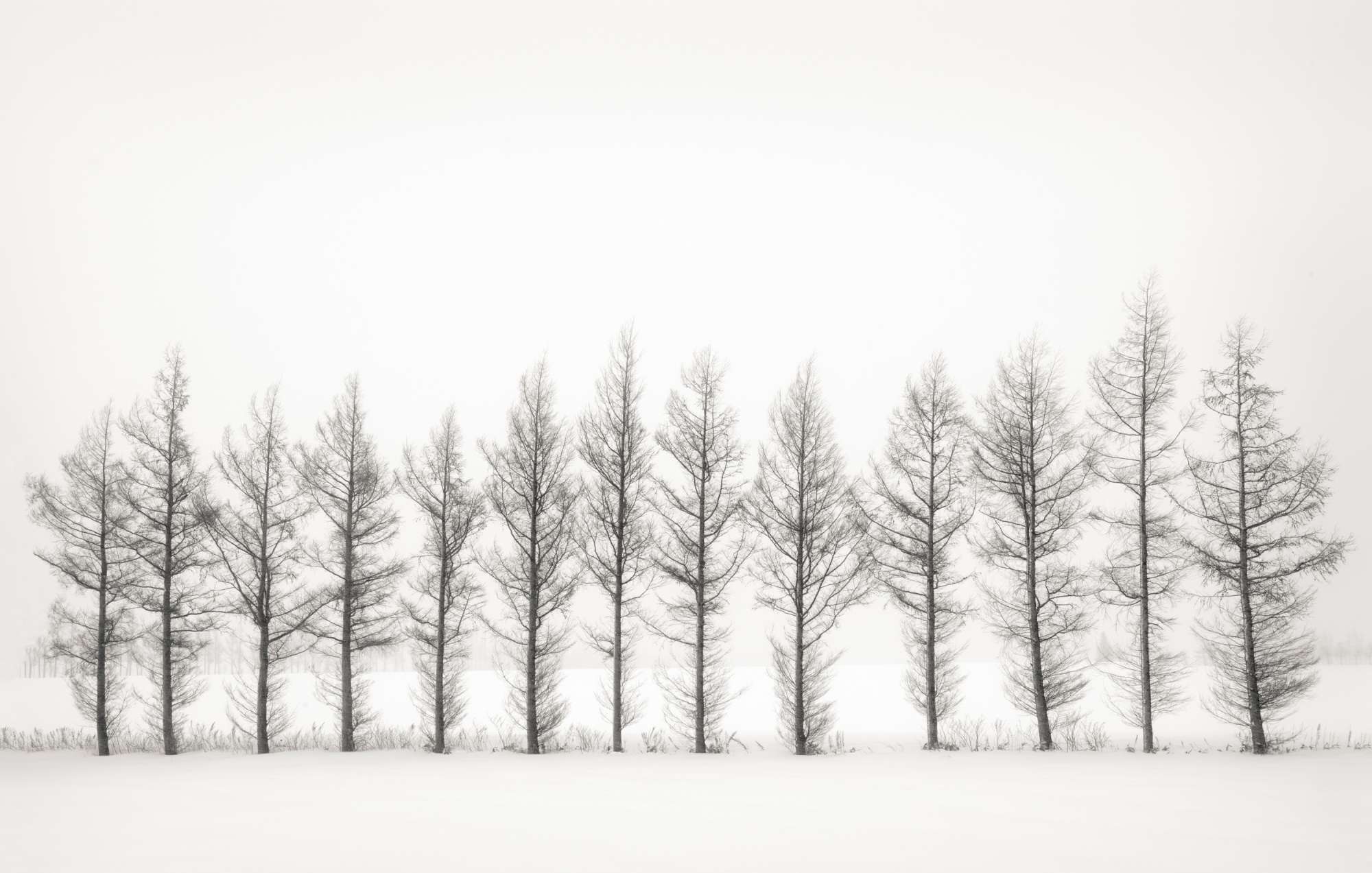
The sensation of remoteness was made quite apparent by the silence of the place with the deep snow and blanketed white open spaces. It seemed that everything was on hold other than the quiet and slow movements of people to local shops in the towns and villages that we passed through. In contrast to the beauty and pristine snow covered landscape, the villages and towns looked tired and worn-out with snow drifts piled high on the road sides with access to homes and shops cut out of them. Cars and gardens were buried in meter deep snow and the only hubs of activity were the local gas stations and 7Eleven stores.
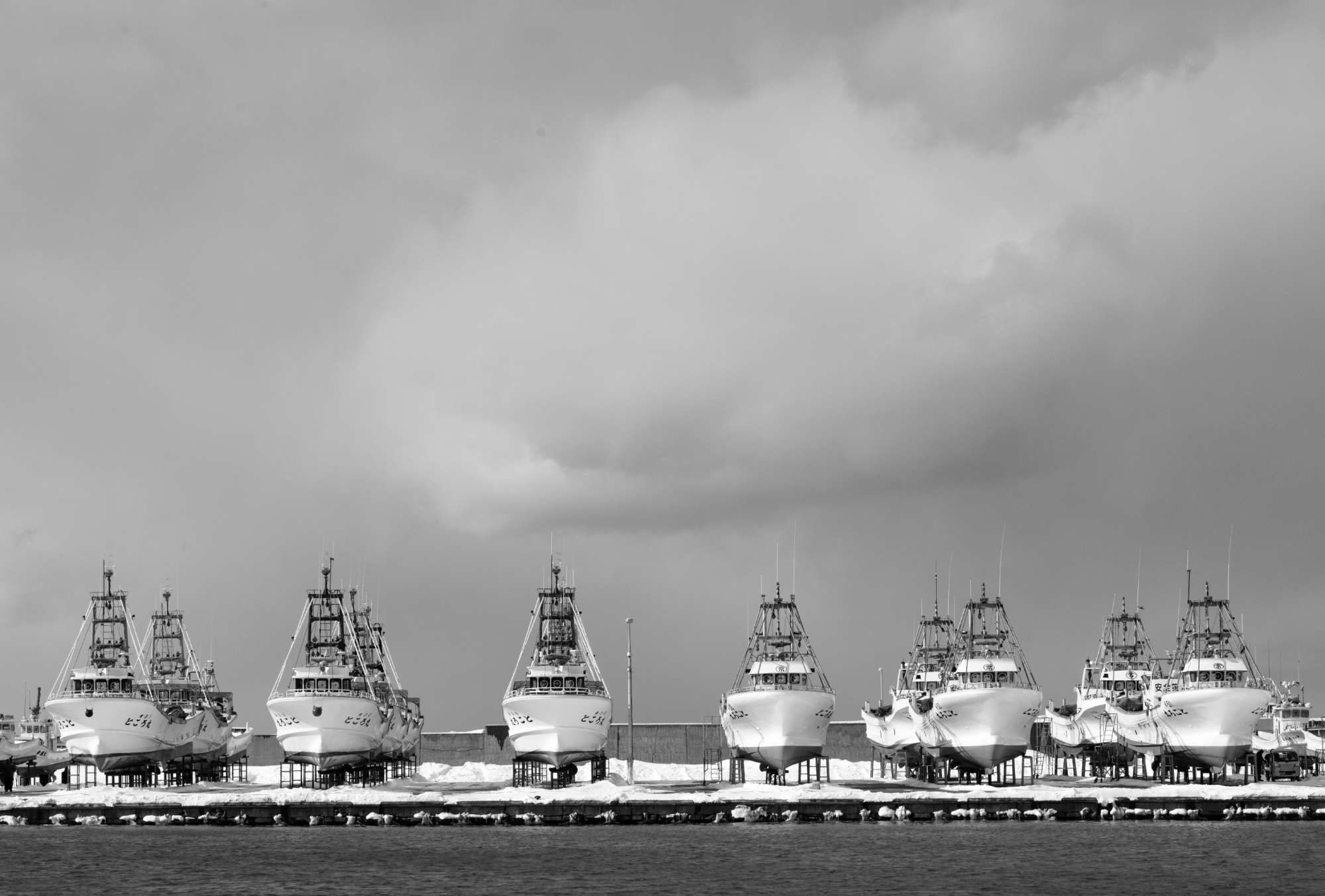
Also at the coast there are hundreds of fishermen’s huts lining the roads that consisted of corrugated structures surrounded by old rusting trucks and machinery, seemingly abandoned, but all of which will be brought to life when the sea-ice melts away upon the arrival of Spring and the fishing season also springs into life.
All of the above added to the ‘feel’ of the place and how the onset of the winter had changed everything for the season. My experience of the landscape was one of mystery and, after a little time, intrigue and excitement. The distillation process that I have practiced all of my career was challenged here as much of my surroundings were already blanketed in white so I wasessentially faced with elements that I had not had the pleasure of seeing before on such a huge scale. Furthermore,
with my passion for the black and white photograph which has been with me all of my photographic career and given the lack of colour other than the blues in the sky, I was beginning to quickly appreciate I was in the perfect landscape for me.
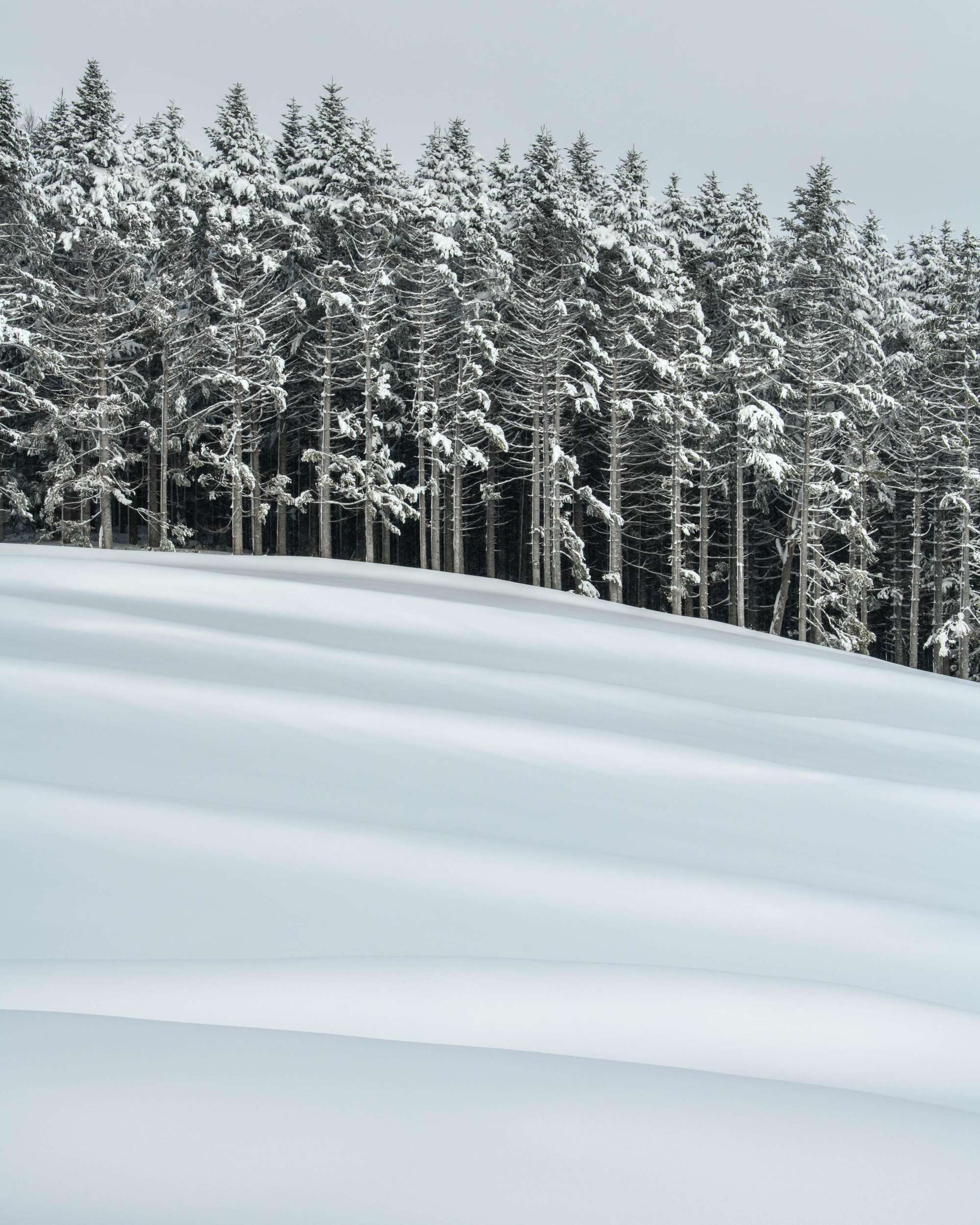
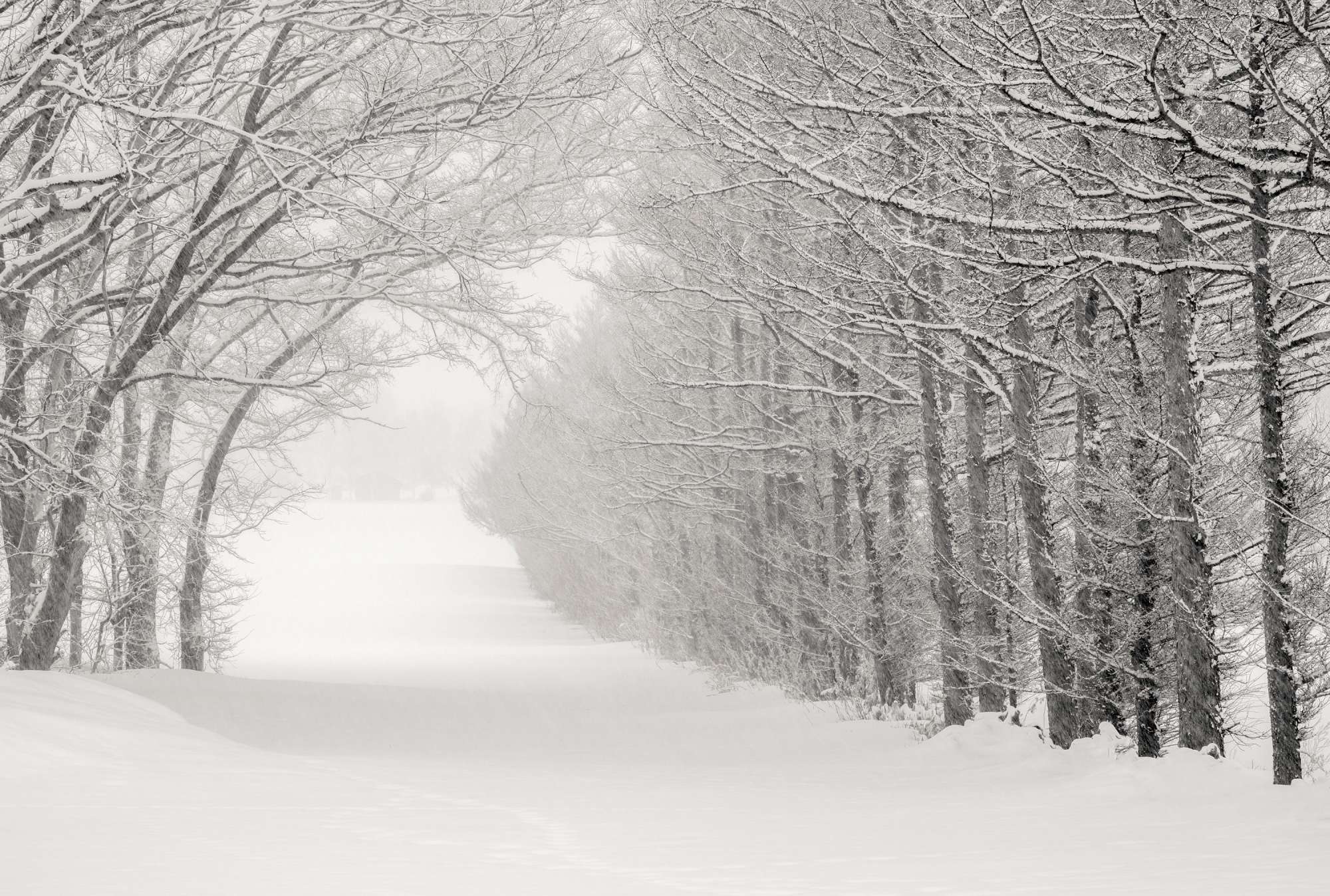
It is often stated that when considering black and white compositions you must first ‘see’ the underlying forms, lines and textures. Along with this we must almost discount colours and trade them for weight, balance, luminosity and tones, which I believe, are the skeleton of the photograph, the very things that will hold all of the elements together. In this landscape I was working with the skeletal remains of industrialised farms and fishing. Everything was there for me, every note in the musical scale so to speak. The only thing left for me to do was to was to arrange them. One of the things any photographer will experience in a landscape such as Hokkaido is the amount of empty, or negative space. It can be rather challenging to consider making compositions that display virtually nothing, white spaces. Certainly working in the UK, we are often faced with a situation of ‘what to put where’ and how that will fit within the four corners of the frame. In Hokkaido that was quickly replaced by ‘where shall I place it and why?
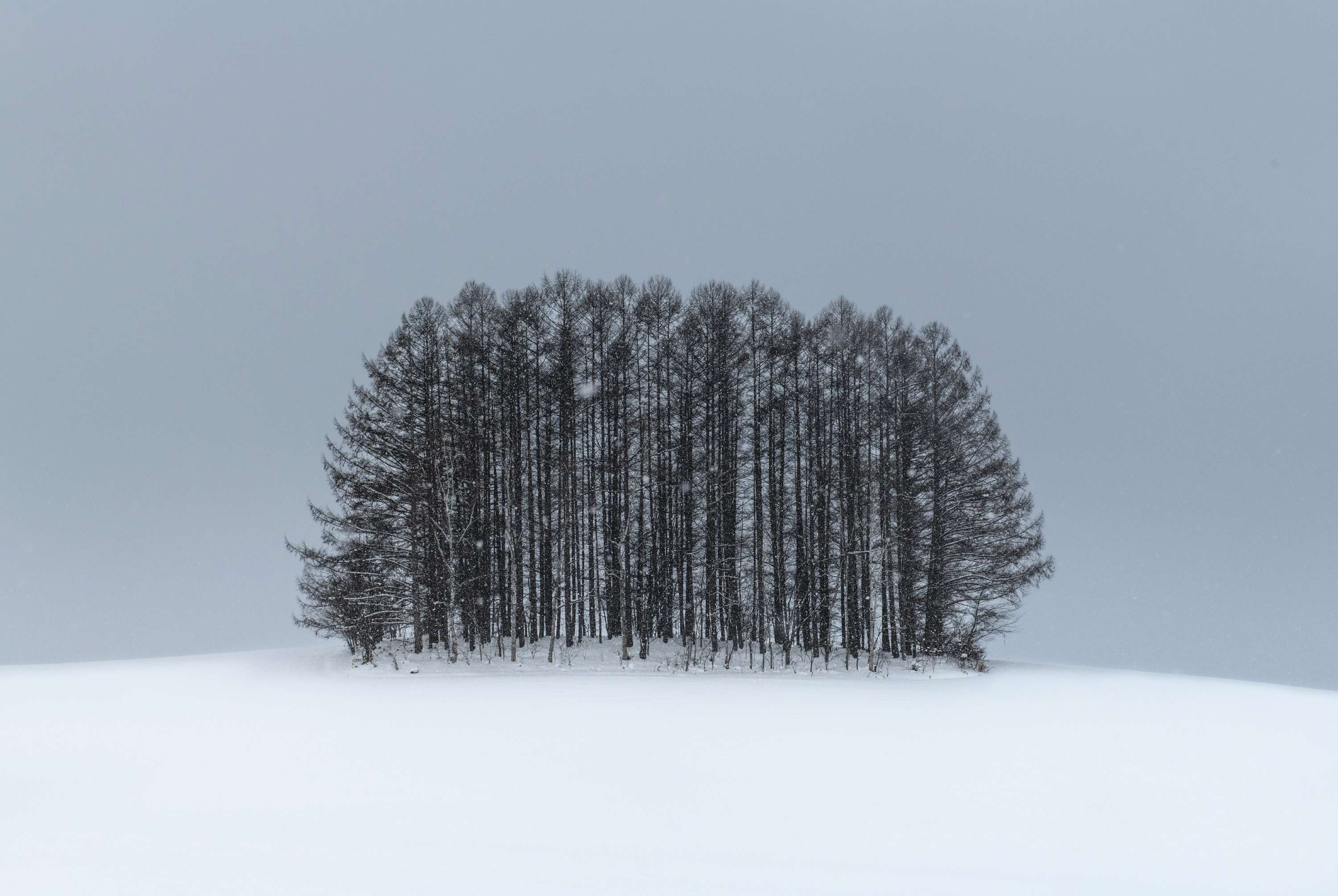
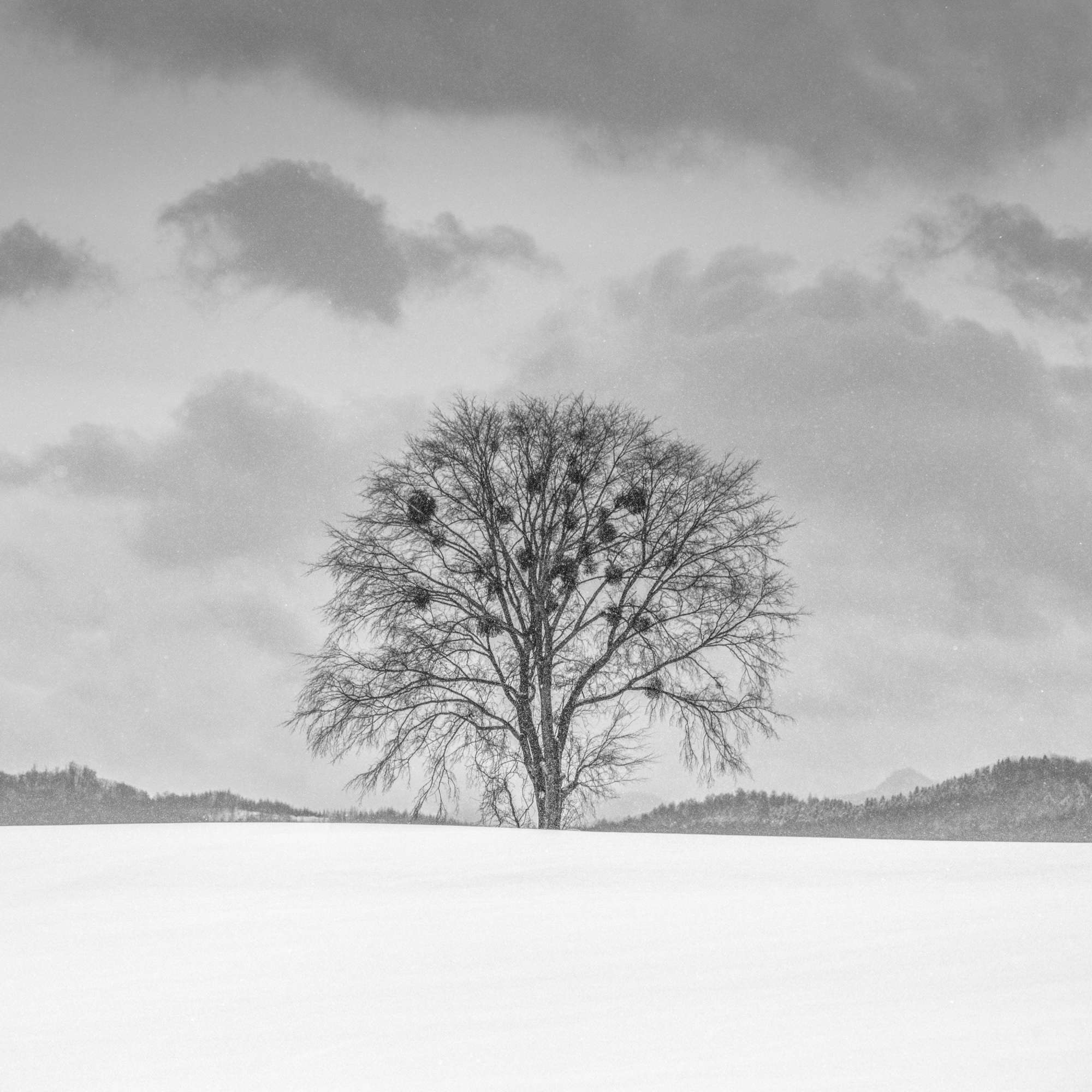
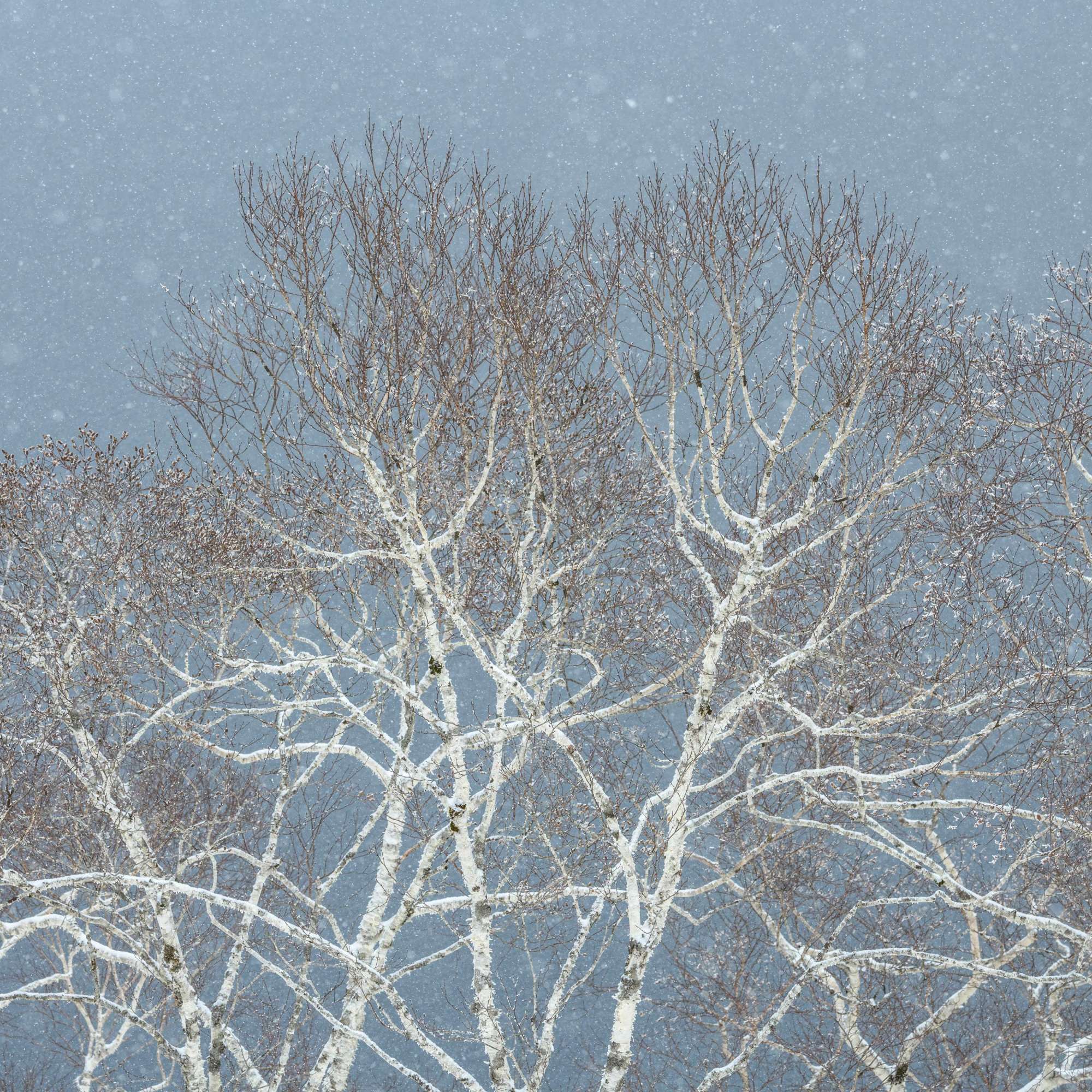
Besides some of the truly natural environments I visited in the mountain areas, most of the lowlands clearly showed signs of mankind. The treelines on the edges of fields that act as a form of wind break from the ferocious winds that come from the surrounding seas. These fascinated me in their uniformity and, quite unlike natural woodland, the trees seem to stand on guard bravely facing the harsh conditions. Trees became a very important part of what I wanted to photograph in Hokkaido and what I did photograph in Hokkaido. I was intrigued how the trees seemed to compliment the open and negative space of the landscape. They accentuated the rise and fall of the undulating farmland as well as being grouped together as copses as if in small communities on hilltops. In the mountain areas the trees were contorted and old with some meeting their final demise in the cold mountain air. I recall vividly one particular afternoon high up on a mountain pass and I saw trees perched high against an ever changing sky that transformed from milky blue with wispy clouds to heavy snow laden grey. The relationship of the trees and the sky changed constantly as did the personality of the trees and their interactions with each other.
It is often stated that when considering black and white compositions you must first ‘see’ the underlying forms, lines and textures. Along with this we must almost discount colours and trade them for weight, balance, luminosity and tones, which I believe, are the skeleton of the photograph, the very things that will hold all of the elements together. In this landscape I was working with the skeletal remains of industrialised farms and fishing. Everything was there for me, every note in the musical scale so to speak. The only thing left for me to do was to was to arrange them. One of the things any photographer will experience in a landscape such as Hokkaido is the amount of empty, or negative space. It can be rather challenging to consider making compositions that display virtually nothing, white spaces. Certainly working in the UK, we are often faced with a situation of ‘what to put where’ and how that will fit within the four corners of the frame. In Hokkaido that was quickly replaced by ‘where shall I place it and why?
Besides some of the truly natural environments I visited in the mountain areas, most of the lowlands clearly showed signs of mankind. The treelines on the edges of fields that act as a form of wind break from the ferocious winds that come from the surrounding seas. These fascinated me in their uniformity and, quite unlike natural woodland, the trees seem to stand on guard bravely facing the harsh conditions. Trees became a very important part of what I wanted to photograph in Hokkaido and what I did photograph in Hokkaido. I was intrigued how the trees seemed to compliment the open and negative space of the landscape. They accentuated the rise and fall of the undulating farmland as well as being grouped together as copses as if in small communities on hilltops. In the mountain areas the trees were contorted and old with some meeting their final demise in the cold mountain air. I recall vividly one particular afternoon high up on a mountain pass and I saw trees perched high against an ever changing sky that transformed from milky blue with wispy clouds to heavy snow laden grey. The relationship of the trees and the sky changed constantly as did the personality of the trees and their interactions with each other.
The signs of farming activity presented themselves in many ways from simple fence lines separating fields devoid of anything other than snow, to greenhouse structures that had been prepared for the winter by removing the plastic canopies as the weight of the snow would crush the simple tube frames. Some of the farmsteads were literally surrounded by a sea of white snow. Travelling across large areas of flatlands these settlements could easily be identified by, once again, the trees surrounding or close to them. Because of this it became a regular occurrence to see a simple stand of trees amidst the open landscape that seems out of place but if you saw the same scene during summertime it would not look out of place anywhere in Europe.
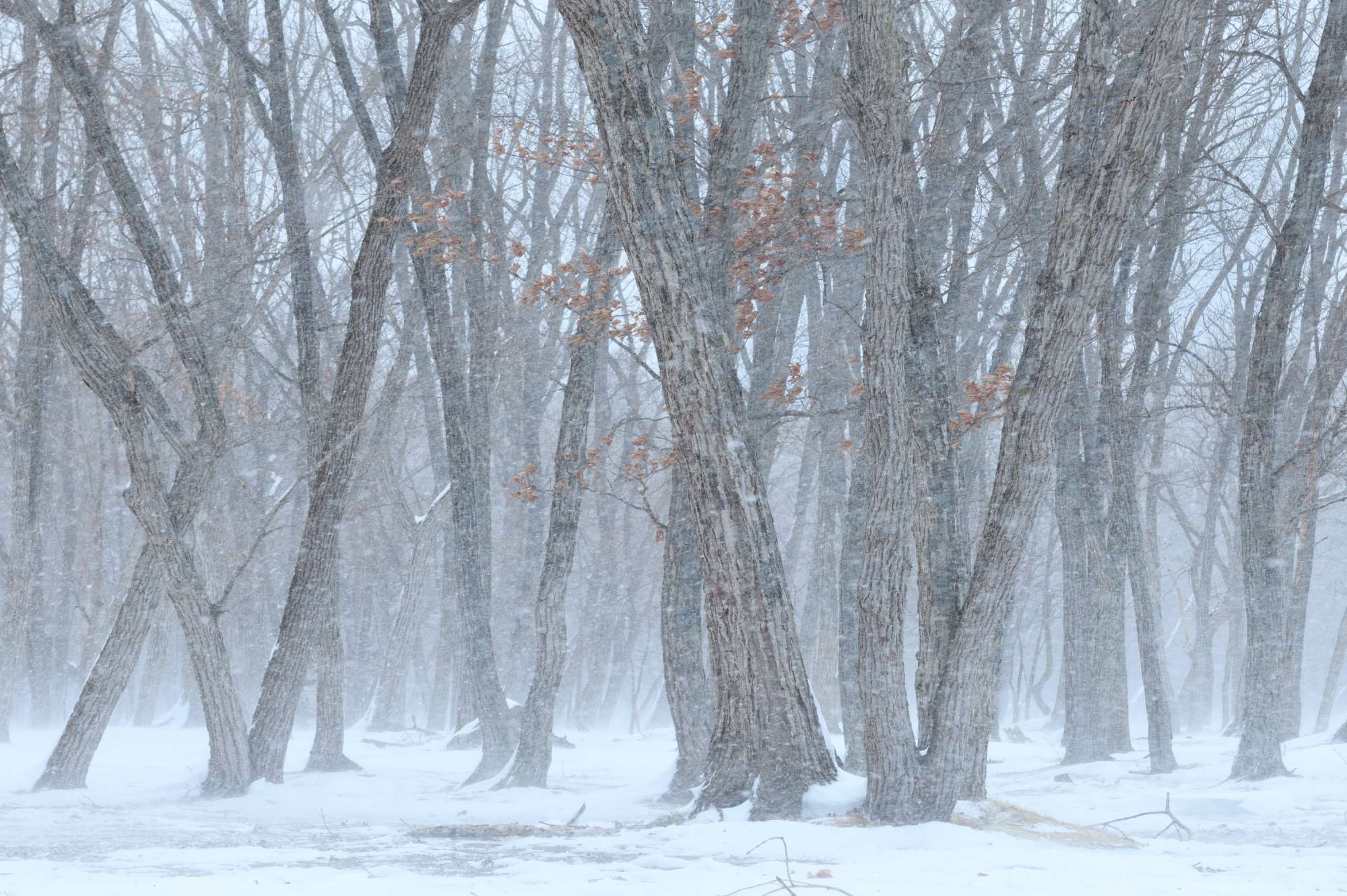
All the time I was in Hokkaido I was working in a landscape that was in a static state. The people there seemed to be almost sitting it out and waiting for the thaw of spring to arrive. The silence the snow causes is quite fascinating indeed. We have all experienced snow at some time and know that it dampens down reflected sound, but when the snow is of this magnitude, nothing but the sound of the occasional passing car and rush of wind will disturb your concentration. At the sea edge the winds can be bitter and if there is a snow storm brewing, as there often is, then the contrast of white landscape and dark clouds above was a reward for me to photograph. The light and cloud can be transient. One morning I was photographing a beautiful area of silver birch trees when the cloud suddenly cleared and the resulting long slender shadows cast from hundreds of trees onto the clean flat snow will be something I will remember for many years to come. The opposite set of circumstances was travelling into a blizzard and noticing how any form of harshness or contrast in the landscape was muted by the amount of wind carried snow. Everything was soft and bright and the trees became ghostly figures in the distance. It was without doubt difficult to work in these conditions and sometimes heading into the field to gain a better position meant you found yourself waist deep in soft drifting snow.
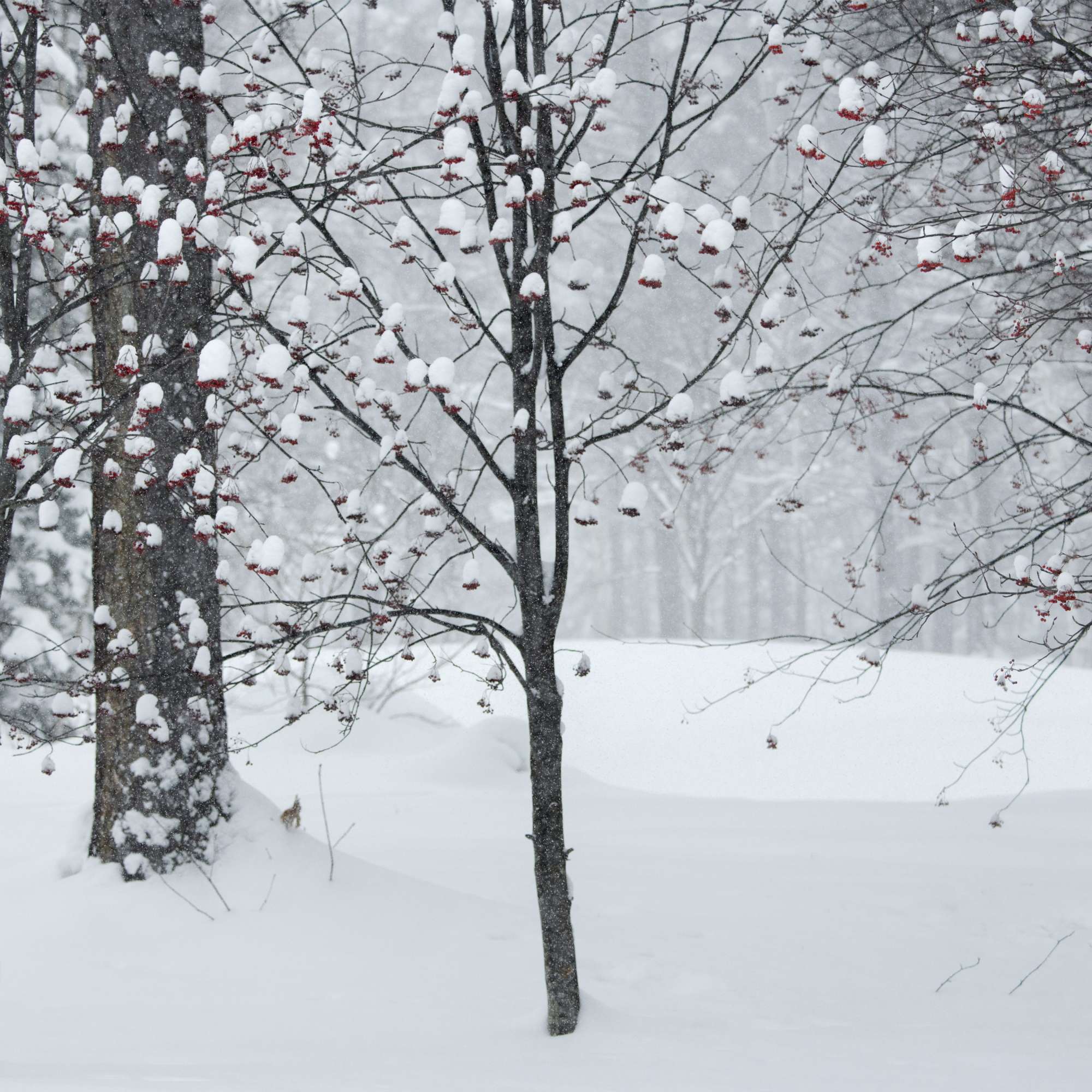
So what are my thoughts now having been to Japan in the winter and left my own footprints behind? I have learned that preconceptions of the wider landscape from photographs are just that, preconceptions, and they can be far from reality. In fact, that is the case for all photography, but in Hokkaido the beauty consists of millions of little facets of the landscape amidst surroundings that you would not expect. It is certainly like no other winter landscape I have photographed before and it was an amazing experience to photograph in a single ‘mode’ for the entire time I was there. What I mean by this is the basic elements of the place remained the same, namely the stark and simple elements of the landscape the winter conditions allow you to see for many months of the year. In a way, the distillation is done and you are actually left with a landscape which you have to distil further in the vast open white spaces. Many names or labels can be applied to photographs of Hokkaido in the winter. Call it “minimalism’ or ‘simplicity’ but in reality it does not actually fall neatly into any category. As I mentioned in the outcome, even my photographs of Hokkaido, for me, have something that is different for me. I understand they are pictures and trees, fences and the coast, but they are in a way graphical, which is true of the landscape itself. What I also learned from my time there is that I would normally aim to seek out a landscape that is as natural as possible, but I felt I became enveloped and relished in the blend of man-made and natural wonders of the winter and the two together were as exciting for me as photographing my first Aurora Borealis, Yosemite Valley and even Glencoe as a young lad. I learned that even after three decades I can still be shocked and wonderfully challenged in locations I am not familiar with and I for one, hope that Hokkaido will become more familiar when I go back and I continue to see the simple and the fascinating in the depths of its winter.